Showing posts with label james cameron. Show all posts

Sunday, April 15, 2012

TITANIC: 100 Year-Anniversary -- A Retrospect on James Cameron’s Blockbuster

by XdarksparkX
Originally written: April 7 – 14, 2012

James Cameron’s Titanic changed my life.  At least, to a degree.  I know that seems like a wrought cliché in 2012, but in this instance it rings true 110%.  It’s what got me interested in the history of the infamous ship, and its what made me an enthusiast of the ill-fated story and subsequent wreck that it claims.  It was one of the key films in my life that managed to illicit such a prominent emotional response from (the then 9-year-old) me that something within said “This is what I want to do with my life: I want to tell stories that move people like this.”
 
Which is funny considering that I frequently state that I am very under whelmed by the first two and a half hours of the film.
 
I could go into a tirade right now, or my usual foaming-at-the-mouth stark ranting mad persona here, but I won’t.  That’s not what this particular write up is about.  I feel like I finally “get” what Cameron was truly attempting to pull out of his audience with this film.  Yes the story he wrote was very basic and utilitarian, and some the characters were one-dimensional, but subsequent recent viewings due to the fast-approaching 100th Anniversary have given me a deeper insight than I had previously claimed in understanding what Cameron was attempting as a whole—particularly with the slow burn of the film.  The ship only lasted 4 days, so illustrating as much of those four days as possible helps drive home the emotional gut check when the inevitable tragedy befalls the “unsinkable” ship.  Thats fairly obvious to some.  Yet there was something more…
 
There was something Cameron captured, something that I haven’t been able to quantify or describe properly, so this is my attempt.  What I do know, is that it’s something that has little to do with the slightly superfluous love-story between Rose and Jack.
 
Let it be stated early in this piece, I believe Titanic is classified as a good movie in spite of the 140 minute love story that proceeds the disaster, not because of it.  Titanic isnt really about star-crossed lovers meeting on an ill-fated ocean liner.  Its a much deeper human interest story whose emotional depths stretches as far down as the 12,500 feet where the remains of Harland and Wolff’s epitome of early 1900s luxury now resides in the North Atlantic ocean.  In fact, all you would have to do is tell me the setup (poor boy / rich girl fall for each other), and then proceed to show me the beginning of the end, and personally I would be just as invested as I was with the final cut.  The love story is basically compartmentalized by the scene where Rose jumps from the lifeboat back on the ship.  That scene is so powerful due to what we know is going to befall the ship, the referential line of “you jump, I jump” only has its emotional power slightly boosted by its previous mention.
 
Now, obviously there are scenes that give us exposition behind Roses life catalyst known as Jack Dawson, since the story is really using first and second person narrative when Rose is recollecting back to the ship.  This exposition is obviously there to make him an endearing character (9-year-old me thought he was a pretty badass dude, all things considered), so I can’t say that it’s entirely a wash.  Still, I stand by my stance that there was something much deeper and more horrific that Cameron was able to illustrate beyond just the sudden birth and swift death of a classic romance.

...Like what happens when you get water in your Panavision film camera.

There are two scenes that are forever burned into my memory. The first is the unbelievably tragic montage to the haunting rendition of Nearer My God To Thee by the ship’s band, with the mother putting her children to sleep before the coming embrace of fate takes them away, and the old couple holding each other as the water rushes in around their bed.  That latter image is probably the only film image that can consistently get me choked up, no matter how much I brace and prepare my mind for it, it always gets me.  It was during this scene, that the light bulb clicked I got what Cameron captured.  It was the horrible, depressing truth of it all. The fact that some of these scenarios likely played out on that ship, stories which we will never know because those who lived them took up their final residence upon the seabed of the North Atlantic a century ago.
 
The second scene was something that further drove this point home, but with far more haunting imagery.  Back in 1998, for the first time in my life, I felt a cold, horrified chill fall over me.  I had watched Scream a year before (my first “real” horror movie), but this was something that truly and completely terrified my soul:  Officer Lowe deciding to go back and save people, only to realize he waited too long when he sees the corpse of a mother and her infant amidst the frozen wasteland.  He then calls to the black,  “Is there anyone alive out there? Can anyone hear me?”  The power in this (again, something that I just realized during recent viewings) was that almost every character we see meet a tragic end was introduced to us at one point or another throughout the ship’s lifespan of the film. It was only when I realized that the woman with the baby was the same one who asked Captain Smith: “Captain, where should I go? Please?” only to get no response, that I literally jumped back as if the Reaper himself had spawned from my television.  Cameron had basically planted these minor characters in your subconscious, so that when he revisited them after the wreck had claimed their bodies, you unknowingly had an emotional connection to seeing their corpses. He managed to somehow throw the despicable fact that we as humans don’t tend to truly “see” people until it’s too late right back into our faces, and haunt our very being while doing so.
 
However, at the very least, Cameron didn’t completely waste those initial 140 minutes.  He used it in an attempt to further our emotional connection to the characters, no matter how seldom that effect might have been in the long run for some of us, it made the movie what it was for others.
 
Of course I can’t write about Titanic without mentioning the infamous “floating door” scene.  I’ve heard some people defend this scene by stating that the reason Rose didn’t insist that Jack simply climb on top of her were the “social norms” and gender roles that were of the time period.  The only problem with this logic is the fact that Rose’s character has spent the majority of the past 165 minutes attempting to buck those trends, and Jack’s entire purpose within the narrative is to further that rebellious attitude.  So how can she look the man who’s been helping her embrace this and NOT once think ‘screw social conventions, this is about life and death’?  It’s not like she was unaware at how frigidly cold the waters of the Atlantic were that night, she had been in there just as he was.  Camerons explanation is that it was not a matter of space, but of buoyancy. If they had tried to balance it out, the door wouldve been pushed down enough where they both wouldve been exposed to the waters enough to the point where neither could survive.  The problem with this explanation is that it leaves a remaining logical fallacy, which comes from the fact that Jack was a bit too perceptive in realizing that it would act as Cameron stated after only one attempt at getting on the door, which came from overloading the same side of the object and watching it naturally tilt over.  I understand the basis of Cameron’s subtext of “women and children first” even until the end, and the duality between the men in her life, as Jack graciously gets Rose on the door and chooses to stay in the icy tomb of an ocean while we are just 20 minutes removed from watching her ex-fiancé beat people with an oar to stave them off from swamping his lifeboat.  Still, the scene just doesn’t sit right with me.

"So Leo, this is where you're gonna die. Now, despite science telling us corpses float (like the ones all around you), all of the heterosexual men who will have to hear about how dreamy you are for the next two years are going to pull you down. It's a symbolic troll-face moment. There won't be a dry feminine eye in the house, and I will proceed to wipe my ass with Charmin Ultra culled from diamonds from here on out. Everybody good with that?  No?  Too bad, let's shoot it!"

I do realize now that there is a deeper subtext that had to take place with Jack’s death, and why I am now at least slightly more forgiving of the scene than I was over the past 15 years.  He needed to die to further the gut punch of the fact that every one of the “forgettable people” (Jack, Fabrizo, Tommy, etc) in the film perish during the sinking, without word or legacy to carry on their memory, save for Rose.  It’s not only to show Rose as someone who was not oblivious to the plight of others (as she had lived it with them, while most of her peers sat in the lifeboats built for 40 but carrying only TWELVE GODDAMN PASSENGERS! *ahem* Sorry, nerd rage moment there), but also as a commentary on the fact that they were the people we connected with.  The good of these characters and the realization that they would “exist only in memory” when they passed, while the people we grew to loathe, despise, or just not care for (Cal and Rose’s mother Ruth) would pass on some frame of remembrance and historic mention simply by their position in life.  I dont think it’s as much about Rich=Bad; Poor=Good (though its very easy to take that away from it given how the character archetypes played out), but more of the fact that the cold truth of our world is that some of the best people will be forgotten in favor of those in more lucrative social standings.

Despite both actresses who played Rose claiming to believe different, Cameron stated, “I want people to decide for themselves whether or not Old Rose died in her sleep, or is simply dreaming.”  It’s interesting that he said that because upon close examination of the final scene, 9-year-old me got chills when I realized that everyone, and I do mean EVERYONE who died the night of the sinking is present in the Grand Staircase when she reunites with Jack.  Fabrizo, Tommy, and Mr. Andrews are obvious selections.  As are lesser ones like Trudy (Rose’s stewardess aboard the ship) and John Jacob Astor.  However, upon further viewings, there are characters in which Rose had little to no actually physical interaction with (that we saw at least) that make an appearance.  Captain Smith, Officer Murdoch, Cora (the little girl Jack was originally dancing with at the lower class party he takes Rose to) and her father, and even bandleader Wallace Hartley and his troupe.  All of whom we can safely assume perished on that horrific night, all of whom are present.  This is primarily what leads me to come to the conclusion that Camerons intention was that she really did pass away that night, an old lady warm in her bed, just as Jack had envisioned for her.

Monday, November 21, 2011

Film School: Technological Evolution's Impact On Storytelling

by XdarksparkX
Originally written for COM 312 - "The Modern History of Film"
March 27, 2011

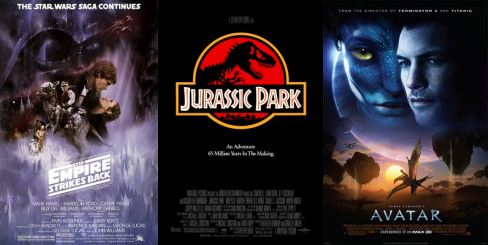
Star Wars: The Empire Strikes Back (1980), Jurassic Park (1993), and Avatar (2009).  These three films have one major thing in common: they are each considered great leaps in terms of cinematic visual effects for their time.  Empire improved upon the fantastic practical effects from it’s predecessor, A New Hope and managed to use matte paintings, miniature models, puppetry and stop motion animation to their fullest extents; Jurassic Park used gigantic audio-animatronics aided with subtle amounts of computer-generated imagery (or CGI) to bring back creatures thought to be extinct 65 million years ago; and Avatar showed the true technological capabilities of pure CGI and performance capture in the 21st century by creating a highly emotional and believable alien race who inhabited a fantastical alien world.  But were any of these leaps required in order to properly sell and enhance the story arcs in these films, or were they simply a case of the filmmakers being nitpicky in how their film was presented?

James Cameron was originally supposed to begin pre-production on Avatar immediately after the release of Titanic in 1997, however after numerous production tests he found that “technology was not where he wanted to be to realize his vision”.  While one could argue that he was right, one could also argue that after seeing the finished product of Avatar, it wasn’t a lack of technological advancements as much as it was Cameron’s own refusal to relent.  I believe the story of Avatar could have been told in the early 2000s with creative workarounds and a desire to make the story simply work.  For instance, was it important that the Na’vi be 10 feel tall (a design choice that surely helped sell Cameron on using CG when they would be interacting with humans)?  In the context of the story, no, their height holds no bearing on whether or not the story itself works or fails.  So the real question becomes, was it necessary to not only completely computer generate the Na’vi, but to spend 237 million dollars (The Wrap, 2009)—the fifth most expensive budget nominally as of this writing (The Numbers, 2011)—in order to tell this story?  While an epic fantasy movie like Zack Snyder’s Sucker Punch, which deals with outrageous imagery like giant Samurai’s and Dragons populating a dream world, manages to only claim an estimated 82 million dollar budget (Los Angeles Times, 2011).  Snyder’s previous film, an adaptation of the acclaimed graphic novel Watchmen in 2009, consisted of a completely computer-generated Doctor Manhattan.  While this was one character as opposed to an entire race, a convincing fully realized CG character using performance capture was still fit into a 138 million dollar budgetary constraint (that had to deal with Snyder being adamant about building sets rather than using vast amounts of chroma key compositing like he did with 300).  Avatar’s budget numbers don’t even included the money spent for on developing the “necessary” performance capture and 3D camera technology that were funded separately (Vanity Fair, 2009).  So what does all this mean?

Its possible that Cameron was simply blasé with his budget, because when Twentieth Century Fox was hesitant to take the monetary risk on Avatar, he himself went ahead and put forth the money into developing the 3D camera technology he wanted (BussinessWeek, 2010).  By using his own funds to develop the tech, perhaps he had the wiggle room within his production cost wallet to experiment with said technology and attempt new filmmaking ideas and concepts, rather than to do something he knew would work for possibly less.  All of this could point to the reason why a lot of critics, myself included, found the story of Avatar to be the weak link of the film at times.  When I finally got around to seeing it, I just thought that the effects weren’t so much for the story as much as they were for Cameron.  In a sense, Avatar was a tech-demo—Cameron’s way of showing just how powerful the technology we have available is.  The visuals of the film are gorgeous, however in this regard I feel that visuals and storytelling in film have a relationship akin to that of game play and graphics in the video game industry—just because your game is pretty, doesn’t mean it’s great if the controls don’t work.

29 years before Avatar started bludgeoning box office records three times over, Star Wars Episode V: The Empire Strikes Back came around, and got its story across by making due with what it had, what was feasibly obtainable, and what could be created in 1980.  It’s budget of 18 million (roughly 47 million when adjusted for inflation) held up enough to get the visual effects to the point of believability, and some could argue that’s all that’s needed.  Sure, as Luke’s little mount known as a Tauntaun gallops across the frozen plains of Hoth in the opening sequence, we know it’s unnaturally stiff and therefore not actually real in the context the movie is telling us it is. But perhaps, because of the fact that the creature was an actual miniature that existed within this world, our level of acceptance stretches farther because random anomalies like unnatural lighting glitches don’t exist.  Perhaps we’re also already engrossed in what the film is selling due to the physicality that model brings, and therefore the slight that arises isn’t enough to jar us out of the moment the film is putting us in.

The reason for pointing out Empire as opposed to its predecessor A New Hope (which holds many more similarities to Avatar production wise), is that it while A New Hope contained the formation of Industrial Light & Magic (who would go on to be one of if not the biggest effects house in the world), it was the Hoth battle scene at the beginning of Empire that I really wanted to touch on.  Yes, it may be more time consuming to do stop-motion animation (or in this case, “Go-Motion”, ILM’s own version of stop-motion animation developed in conjunction with Phil Tippett), but in the end those stiff and slightly awkward movements only fit to make the Imperial AT-AT walkers look all the more realized.  As seen with the many “special editions” Lucasfilm has churned out of the original Star Wars trilogy with “updated effects”, newer isn’t always better, and the story itself does not suffer if one watches the theatrical cuts of the original trilogy—difficult as they may be to actually obtain—with the original practical effects intact.  I personally feel that the newer effect almost cheapen the films, rather than enhance them as Lucas intended.

The reason for this being that when you have practical effects, the viewer knows that its something tangible, something with weight that existed on the set.  The lighting is the same, the shadows are the same, the colors and textures are the same as the human actors and everything else on the set, because it’s actually present.  When Mark Hamill speaks to Yoda, he has not only the puppet and its movements for visual reference, but Frank Oz’s own performance to play off of.  When interacting with a pure CG character, seldom is there a time where there isn’t at least a partial disconnect due to the awkward nature of having nothing in essence to work with.  Perhaps this coincidentally explains why Cameron wanted so much of Avatar to be CG.  By making the Na’vi themselves CG, it makes them seem more at home with their CG-laden homeworld of Pandora and the other indigenous creatures it claims.  In that regard, I understand his thought process through the technology/story connection, but I don’t know if it completely sells me on it, because in scenes where the humans and Na’vi are interacting (like during the climax when Neytiri holds Jake’s asphyxiating body in her arms) there is something just… off that just doesn’t make what I’m watching believably real.

All that said, surely it would seem impossible to make anything CG seem tangible within a film—to get the viewer to believe 100% that whatever they are witnessing isn’t so much a fable as much as it is a documentary of fantastical proportions, while never allowing their minds to really slip into the uncanny valley.  However, in 1993, a thunderous boom echoed out, and Steven Spielberg shut down the perimeter fences and unleashed Jurassic Park upon the world.

Originally, Jurassic Park was set to use “Go-Motion” for the dinosaurs during long shots, and Stan Winston’s animatronics for the close-ups.  However, after the Go Motion test animatics and various attempts at motion blurs proved unsatisfactory to Spielberg, two animators began working on a CG T-Rex skeletal walk cycle, and upon review were approved to do more.  The first full CG animatic they showed Spielberg and Tippett was of the T-Rex hunting a herd of Gallimimus.  The exchange between Spielberg and Tippett after witnessing this feat—“You’re out of the job”; “Don’t you mean extinct?”—found its way into the film, and was ironically the beginning of the end of the practical effects era.

However, perhaps it shouldn’t have been.  For while the advent of CGI in this regard was huge and the primary focus of the praise of the film’s effects, maybe the true praise should’ve been put on the seamless transitioning of the CG dinosaurs and Stan Winston’s fully realized animatronics.  When the Rex smashes through the tour cars roof in an attempt get to Lex and Tim, that was something that could have never feasibly worked on a emotional and psychological level if done with CGI.  The close proximity that the Rex was required to get within pertaining to the children meant that you would have something tangible (the actors) attempting to cater to something intangible (the Rex)—they wouldn’t have been reacting from what the Rex was doing, they would’ve been telling the Rex what to do wherever they moved the shattered plate of glass.  Certain emotions can’t be faked either, like the one of lingering terror that exists in the back of one’s mind when they realize that a giant mechanical T-Rex head is barreling down upon them with the potential horsepower of ten muscle cars.

One of the most iconic scenes in the film comes after the Rex escapes from its pen, and its foot steps right behind an unsuspecting Alan Grant as he tries to free the children from the now overturned tour SUV.  Aside from the shot being beautifully constructed, it’s another instance where no matter what tactics they would’ve tried, it would not have been had the same power and haze of reality if it had been achieved through CGI.  That was real weight from that animatronic skeleton pressing down into that mud, “real” latex skin that folded just right upon its placement.  Tangible, believable… real.

I think the problem faced today is that the current powerhouses of SFX like ILM and WETA are being overworked.  CGI has become such a crutch in the industry that these effects houses are constantly on a time crunch to get anywhere from 200 to 300+ VFX shots finished, approved, polished and finalized.  All before a deadline of say roughly 90 days.  An example of this: say you pull 10 CG artists off the floors of ILM today and 10 from the team that worked on Jurassic Park in 1992.  Today, because films are requiring so many Visual Effects shots to be completed, those 10 artists are probably working primarily on an entire scene by themselves.  Whereas in ‘92 with Jurassic, one person could (hypothetically) meticulously work on the animation of the T-Rex when it breaks out of it’s enclosure, while someone else is specifically working on the rain refraction on the skin, making sure that every drop falls and disperses as it should according to real world properties and that the determined light source is accurately reflected through this as well.  This is just my own theory, however it is obvious that as SFX houses have been spread thinner, the finer details that were seen in Jurassic Park have been lost due to sheer volume of work and time in which to complete said work.

In conclusion, I think that the best storytelling tool is a moderation of both practical effects and computer generated imagery.  CGI has become a crutch, when at its original rise to popularity it was meant to be a tool—a simple technological puzzle piece to aid in bringing a director’s vision to life.  While Avatar is a huge selling point for the true potential of CGI in this day and age, I feel that Jurassic Park showed the power of moderation in a perfect way, and that practical effects don’t nearly deserve the shunning that they’ve received from the Hollywood machine of today.  Not to mention, given the fact that the highly touted stance is that CGI is cheaper than practical effects, if you were to adjust older movies that use extensive practical effects for inflation, few would even come close to the budgets of the blockbusters today.  So how much cheaper is CGI really?

Perhaps it’s a joke—a metaphorical knock-knock with an unknown punch line.  How many licks does it take to get to the center of the money pop?  The world may never know…

_____________________________________
Patten, Dominic. The Wrap,
http://www.thewrap.com/movies/article/avatars-true-cost-and-consequences-11206 (2009).

The Numbers,
http://www.the-numbers.com/movies/records/budgets.php (2011).

Los Angeles Times, 
http://latimesblogs.latimes.com/entertainmentnewsbuzz/2011/03/movie-projector-diary-of-a-wimpy-kid-rodrick-rules-sucker-punch.html (2011).

Vanity Fair,
http://www.vanityfair.com/online/oscars/2009/12/how-much-did-avatar-really-cost.html (2009).

BusinessWeek,
http://www.businessweek.com/magazine/content/10_05/b4165048396178.htm (2010).

Saturday, May 8, 2010

Does Not Compute: James Cameron's "Terminator" Films

 by XdarksparkX
Originally Written: May 8th 2010
[Images from AllMoviePhoto.com]

Let this preface clearly state that James Cameron's Terminator films are awesome. Both films are heralded classics within the Sci-Fi/Action genre due to their deep lore and engrossing universe. However, there is one thing within the core of these movies that, when approached with basic logic, brings every possible suspension of disbelief crumbling to its knees:

JOHN CONNOR CANNOT EXIST.

That’s right, and I don’t mean that in the “Terminator-Mission-Log” way either. It is literally physically impossible for John Connor as Kyle Reese’s original future knows him to exist.  Whoever John Connor was in the original timeline (you know, the one that contained the events that allowed Kyle Reese to go back in time in the first place) doesn’t exist, he is theologically erased.  Why?  Because whoever John Connor’s father was in the original timeline now never meets Sarah Connor, much less has sex with her. Instead, Kyle Reese gets her between the sheets, knocks her up, and he becomes the father of John Connor. Way to royally fuck the human race over by having her bring Edward Furlong into the world, asshole!

Ladies and gentleman, courtesy of Kyle Reese, I give you The Savior Of The Human Race!
His prime directive: shouting “MEEEAAAAMMM!” every five minutes in an abhorrent screeching whine that will only be rivaled by Eric Cartman.

This slip is especially funny though, because T2 goes out of its way to drive the point home that: “there is no fate but what we make.”  Yet that’s obviously flat-out bullshit because John Connor still turns into the bad-ass leader of the resistance with two completely different fathers!

Now, I’ve heard some people attempt to defend this by saying that you can’t ever find the beginning to a circle, and that’s why Kyle Reese being John’s father works.  The problem is, time progression as we witness and experience it is linear.  Okay, let me make my point simple.  Think of time in the sense of a piece of string.  Now, as pivotal / memorable events happen, you tie a knot at a certain point in that string.  So eventually you’d have this piece of string with knots at various points.  Now suppose you suppose you added a time-travel variant to this idea, and decided that at the tenth knot you wanted to go back to the fifth.  If you go back, no matter how you alter it from then on, that knot still exists as it always had when it was originally formed.  Someone had to be John Connor’s father before Kyle Reese made his trip back in time, because in the linear progression of events that the humans who witnessed the first resistance had to experience in order to get to the point where they send Kyle back in time, he was born chronologically after John.  This whole ‘time as a loop’ thing doesn’t work within the basis of what needs to be accomplished in the narrative of the films.

Therefore, with this in mind we can only come to one conclusion: Edward Furlong’s whiney bitch of a character does not grow up to be the savior of the human race.  The whine-box that sounds like nails on a chalkboard becomes the sorry son of a bitch that joins the Resistance and gets his ass blown up for being so goddamn annoying and attempting to blindly retreat without any cover fire what-so-ever.  That’s the John Connor you have created Kyle Reese, LIVE WITH IT!  The man we come to know as John Connor in Salvation and afterward has no connection.  He was a wandering rogue, who had decided “enough of this Skynet/Cyberdyne bullshit” and started turning T-100’s into scrap metal with nothing but a handgun and a hunting knife like a total boss.  Naturally, everyone who came in contact with him assumed that he was “the prophesized savior” and he was too devil-may-care to give a shit, especially since he couldn’t remember who he was and it was more convenient for people to address him with a painfully generic “normal” name like John Connor rather than his accepted code-name of Roguee McBadAss.

This man clearly has no relation to the child above. The discrepancy of Awesome between the two is far too great.

I honestly think when it came to T2, Cameron wanted to make an apocalyptic movie about us not knowing the power we wield and choosing our own fate by our actions in the present, and someone somewhere in the writing process came along and said “ya know, this would be a great sequel to Terminator.”  Granted, this is nothing more than my own little conspiracy theory, but it at least gives credit to Cameron in saying that he’s not so blind to basic continuity that he would have the balls to have a line like “there is no fate but what we make” featured so prevalently in a movie when his protagonist is still set to be the future savior of mankind despite two different male parental figures (because if he wasn’t, Skynet damn sure wouldn’t waste the effort sending Terminators back in time to off him).

That brings up another logical fallacy, what the hell was up with Skynet going THE WRONG WAY when it’s assassination attempts on Connor were subsequently thwarted?  Unless there's a bit of exposition I missed that tells me there’s some type of limit to the time-travel technology, there is no logical progression that a highly advanced network of computer intelligences would follow that would lead them to think that attempts LATER in John Connor’s life rather than EARLIER in the family lineage would be the more successful venture.  That brings back another point, if Skynet initially had gone back and attempted to killed Sarah’s mother while she was pregnant with her, and Kyle went back to protect John’s grandma, then the whole “time is a loop” theory is thrown out the window into the horse manure.

I don’t want it to seem like I dislike these films, because I don't, but this was more of a pointing out that the original two films don't have as solid a narrative structure as a lot of people seem to believe they do.  That doesn’t mean that these aren’t good films, or that their contribution to cinema is somehow diminished, it just means they possibly aren’t as deep in certain aspects of the plot as people would like to believe.  And that’s okay.  Cameron more than makes up for these logical fallacies with the elaborate and detailed timeline of Skynet’s rise to prominence, and if that’s where the primary focus was, then it’s a trade-off that I’m completely content with.