Showing posts with label film. Show all posts

Saturday, May 17, 2014

Magic Mike

by XdarksparkX
Originally Written: May 17th, 2014


Well I'll be damned. Ladies (and some gentlemen), I apologize. I thought Magic Mike was just a stupid exploitation film. I'm here to admit it, I was wrong.

Magic Mike is worse than an exploitation film, it's an exploitation film that tries so hard not to be one on it's downtime, it ends up bogging itself down with some of the most mind-numbingly boring melodrama I've ever seen written for film. Magic Mike's script is akin to walking into a wall repeatedly to kill time before you eventually leave out the front door, like you were supposed to do hours ago.

I can hear the knee-jerk defense from a very certain section of the audience coming already, "you just don't understand it; it's a 'girl' thing." Well now hold the fuck on there, Gladys. That statement toes the line of sexism. For a film that seemed to be crusaded by the idea of gender equality (in that there are far more movies concerning the exploitation of women than there are of men, though if you ask me that seems to be logic that was the prime example used in the creation of the turn of phrase "an eye for an eye makes the whole world blind"), it would be dubious at best to assume that I cannot "get" a film simply because I have a penis, just as it would be ridiculous to say that a woman can't "get" a film because she's a woman. If someone of the female persuasion told me they didn't like Fight Club, Jurassic Park or Django Unchained, people would call for my head like I had committed high treason in the Game of Thrones universe if I uttered something even close to the phrase: "you don't understand [these films] because you're a woman". Likely because this is a stupid, close-minded bit of reasoning.

However, to imply that what I watched in dazed confusion for two hours yesterday was something with such nuance and subtext that it can only be seen by having a different set of genitals, or having a higher estrogen level, or by removing my freaking Y chromosome is probably the most blatantly raging bout of 1930s styled gender bias I've seen since the debate about a woman's rights to her own damn body hit the fan during the 2012 United States presidential election.

I hate to break this to some of you swooning fans, but Magic Mike isn't smart or intelligent. There isn't any deep subtext that only you are in tune to. It's a shallow story that orbits around scenes of guys flailing their junk in women's faces. Know that if you attempt to deny this, it will look just as ridiculous as if those attracted to women in your life tried to fabricate some deep, existential subtext of Debbie Does Dallas. As long as we're clear on this fact about the movie, we can move forward.

I will say though, being a straight man obviously does not allow me to understand the clear-cut sex appeal of the movie. The thing that had me confused though was, I don't get why some women chose to act like they've never seen a good looking guy with his shirt off until this movie came out. To play a very controversial card, I don't see many sober straight guys doing that when a chick breaks out her set of twins in a film. The ones I do see doing that are either 12 years old, drunk off their ass, or fucking clownshoes, and who wants to deal with any of those idiots anyway? Maybe the guys I hang out with have all come to terms with being desensitized to it, and maybe part of the whole equality movement is that if guys can openly be horndogs when they see strippers, so can women. (Though why exactly you would want to be the female equivalent to those aforementioned clownshoes I have no idea. Oh well, different strokes for different folks.)

Oh, but wait. One of my best friends, who is female, flipped on the movie while channel surfing and bored to tears. She was ten minutes into tearing the movie to shreds before I even got a comment in. Excuse me, could you open that window over there? I have a theory that might need to be thrown out. Appreciate it.


Clearly she and I are just crazy though, because even Rotten Tomatoes -- as of this writing -- has the film sitting at an 80% fresh "approved" rating. I was close to smashing my head into the nearest wall when I found this out, until I realized this rating might be due to the critics crediting man behind the camera: Steven Soderbergh.

For those of you unaware, Steven Soderbergh has directed many critically acclaimed and commercially successful films such as: Erin Brockovich, Traffic, Contagion, the Ocean's Eleven remake, and what most consider his tour de force: Sex, Lies and Videotape.

I on the other hand don't give two flying shits about who directed it, and will not be granting any points to the movie because of this. Steven Spielberg went and made Indiana Jones and the Kingdom of the Crystal Skull for fucks sake. There is no precedence for a movie being a guaranteed piece of cinematic mastery and genius simply because a very good director happened to be the driving creative force behind it. Directors are human and they phone things in or make stupid choices from time to time. My all-time favorite director David Fincher admitted to phoning in Alien 3, and one could argue his direction of some of his more recent films like The Girl With The Dragon Tattoo was uninspired. Magic Mike reeks of Soderbergh simply shrugging his shoulders half the time and saying "whatever."

Roughly two-thirds of the way through, I found myself feeling sorry for any woman who went to see this as the male exploitation film it was advertised as. The strip club and other "dance" scenes seem like they only take up 30 or 40% of the movie. The rest is filled with snooze-inducing melodrama. I'll admit, I have found myself being a sucker for intriguing melodrama (I fully admit to watching CW's One Tree Hill and 90210 in their entirety for crying out loud), but the melodrama in Magic Mike is so painfully uninteresting and uninspired, a day of long and tedious dental work seems like a more attractive alternative to watching it again. It's like watching everyday people have mundane everyday conversations, which amounts to actively trying to weed out the bullshit filler to find the lines that are actually supposed to be character or plot development. 

The characters all feel like the transformations they go through are so minimalistic. Channing Tatum's title character wants to open his own business, and make something of himself and not be a "40 year old stripper". Admirable. What happens in the end? He quits his stripping job, goes head-on into the uncertainty of unemployment because he finds out that his boss has no loyalty to any of his workers. *gasp* No, really!? I'm sorry, what made you think the guy who wants an empire of strip clubs wasn't running primarily off of greed and willing to throw anyone in front of the train for said greed? Is it because it's Matthew McConaughey? It was because it's Matthew McConaughey, wasn't it. 

"It's totally because it was Matthew McConaughey. 
I mean, dude won an Oscar bro!" 

Nothing of Mike's personal situation changed, he still needs to pay his bills, and he still has a shitty credit score. So...why didn't he just do this in the first place? "Wanting to make something of myself was a good pipe dream, until I found out that I was just a cash machine to my boss. This betrayal of trust! This... defamation of my morals!"  Maybe I missed the point where McConaughey said he'd send bouncers to break Tatum's face if he quit, but I fail to see the tactile tension and consequence of this decision that wasn't present before.

I swear, watching some of the scenes outside of the strip club felt like I was reading someone's journal if it read like:

"Got up late this morning. Stubbed toe trying to get ready. FML.

Rain is stupid. Late for class. Teacher was a bitch as usual. No assignments though.

W
ent out to eat, good meal. Jenna called, she's cool. I'd hit it.

Hit up this party. Stole some beer. Scored some X. Some chick blew me.

Jeff almost OD'd. Dumbass. How'd I get home?

Couldn't fall asleep. Infomercials are cheesy. Insomnia." 

Now, go ahead and try to say that the dialog is a more realistic representation of life. If I wanted an exact replica of real life, I wouldn't pay ten-dollars to sit in a theater and watch other people live it (or in this case, sit on my ass for two hours staring at a TV). People tend to go to the movies to escape reality, not to be burdened by it's mundane passages. Hell, that's why even reality TV is sensationalized -- true reality TV would be boring as fuck to watch.

The best word I can think of to describe Soderbergh's direction in Magic Mike is lazy. For so many scenes, it feels like this was his cadence: set up the scene, leave the camera on tripod, call action, take Director of Photography and Camera Crew with me to get doughnuts and coffee from craft services, have Assistant Director call cut when the actors finish their lines if I'm not back in time. There is such a glaring absence of medium or close up shots when two people are talking, it made me realize that MTV's The Real World has better and more creative conversation coverage than this movie. I get that it's a stylistic choice, but the problem inherent with said choice is that it takes away from the intimacy with the characters. By feeling so distanced, it becomes hard to "get to know a character". Take the mid shots and close ups David O Russell used in Silver Linings Playbook for instance. The intimacy that both Bradley Cooper and Jennifer Lawrence's characters share is evident from the close ups, and we as the audience begin to feel closer to them because the framing makes us actually closer. How can I get into a story when it feels like the director wants me to stay far away from the forced "plot point" scenes that take up damn near 70% of his movie!? The only reasoning I can think to do this is to make us feel like awkward voyeurs, a feeling one should probably have when at a strip club or similar establishment. You get half a pass here Soderbergh... but just half.

There is also a glaring lack of ambient noise or music during these "wide shot dialog scenes". All I can hear is this deafening silence when someone stops talking. Again, I think this would work if it was coupled with intimate medium shots or closeups on the characters, showing that they are wholly and completely focused on each other to the point where they can't even hear the world around them. There's a scene at a carnival or amusement park with Channing Tatum and his forced love interest played by Cody Horn. They walk through the park, talking amongst themselves. (Dear GOD! Soderbergh used a dolly to have the camera move with them! Be still my heart!) In this scene, there is a jarring lack of ambiance: no crowd noise, no music and sound effects from the games booths, nothing. They sit at a picnic table by a go-kart track, and not even the faint noise from the karts is audible at all. Obviously it shouldn't be as loud as it probably would be in real life, as it would drown out the dialog, but the karts go by damn near muted, and it makes the entire scene uncomfortable. Is that what I'm supposed to feel? Am I supposed to feel uncomfortable while watching this clumsy, forced romantic subplot unfold? Because that's what's happening, Steven.

The ending is probably the worst culprit of just phoned in effort, and contains the biggest "ahh fuck it" move pulled in the movie. After Tatum meets Alex Pettyfer's character, he runs into his sister, the aforementioned Cody Horn. Her entire one-note throughout the movie is "protect my brother Mike", but when the ending rolls around, both she and Tatum basically say "fuck that kid", figuring he's beyond help and let him go to probably die in a ditch down in Miami somewhere from a lethal combo of hookers and blow. Lovely! 


"Well, I got you into this, but I guess you're just too far gone for me to even feel semi-responsible for your downward spiral. Oh, your sister says 'fuck off' too. Welp, see ya at the morgue when they ask me to identify your body!"

And after such a weak buildup of Tatum wanting to do more with his life, and Horn's brother falling into "the fast life" of a male stripper and taking up Tatum's mantle, everything basically culminates to the fact that despite Tatum wanting to be treated as more than just a guy who's only worth his six-pack, that's essentially all he's treated as in the ending. Horn smirks when he says "what can we do for seven hours" before jumping across the table to make out with him. So, the difference from the beginning is that he won't be making money, and he now has no job, and has a credit score in the toilet... but he's... happy? Because... of... stuff? And will do... something with his life? Maybe? I honestly don't have a fucking clue. The movie ends on such an abrupt point that everyone comes out looking like lost dumbasses. Is that what this was supposed to be? A relation piece for dumbasses to not feel so dumb, because poorly written characters in an exploitation movie are also... dumb?

Overall, there is a general hollow feeling to everything in Magic Mike. Nothing feels concrete in it's presence. Maybe that was the intention, but if it is, is the movie trying to say that Tatum's character is so broken from his ordeal at the strip club that he now even views romantic pursuits as hollow endeavors?

After all that, I'm sure there are people who don't get why I do this, why I tear down movies the way I do on here. I've heard some of my friends say they don't believe I actually like movies, because I tear down so many. Well, lend me your ear and I shall tell you the method to my madness courtesy of Morgan Freeman.

"Because every time I show up and explain something, I earn a freckle."
-South Park's Morgan Freeman

Making movies at the level of nation-wide theatrical release is a very rare privilege. Those able to make these movies are granted a gift every time a studio or production group picks up a script and green-lights a project. They are given an almost demigod level of power, to reach out to people from all different backgrounds, cultures and faiths. And for the time of 90 minutes to 3 hours (more if they split one movie into two parts like they've been doing recently), they are able to tell a story that can make every one of those people forget about those meaningless differences and unify a group of creatures who seem to constantly find themselves focused on the idiosyncratic rather than the harmonious.

Movies can bring us together. They can empower us, enlighten us, and open us up to empathy with people or groups we had previously written off. When I see a movie that seemingly throws this gift away by being lazy in it's message or story, it feels like I'm watching as this gift is squandered. This gift is something I want to be given one day. I will likely be struggling for a very, very long time to obtain said gift and get my stories told. But in everything I write -- no matter how silly or crazy it may be -- it always maintains the core that people will be able to see a reflection of themselves, or someone they know. I want them to be able to connect with the journey, or with the characters involved. To offer a differing perspective that allows them to laugh at the pains of unimportant everyday struggle, or to realize something they hadn't before. And for those who were like me, I want a very special group of people to realize that someone else feels the way they do, and that if this movie says nothing else, it says that they aren't alone is this fucked up world.

Now, I'm not saying every movie has to be a deep work of art, and I'm not saying Magic Mike doesn't have it's place in the world. There's a sequel coming out, and whether the script is inspired or not, I'm sure it will make just as much bank as the first one. One of my favorite filmmakers, Writer / Director Kevin Smith, once described the concept of critics to the art of filmmaking perfectly: "Who is anyone else to tell you that your art is wrong, man? That you failed to express yourself through your art?" He has a very good point, and it's made me re-evaluate how I critically assess movies. However, his comment doesn't deter the reasoning for this site. For this movie, and for almost all of the movies that have articles on here really, I'm pointing out things that didn't allow me (or any other contributing writer) to connect with what is being presented from a storyteller's perspective, not an artistic one. If I can't connect to the characters, it's hard to see their plight as anything other than trivial. When Alex Pettyfer's character overdoses halfway through Magic Mike, I don't feel any sort of tragedy because I lack a true connection with his character. That's what a directors job is when a film introduces a narrative. It's exactly why I rip the Transformers sequels to shreds (God help me, even more are on the way...). No one in the audience -- short of the 5-year-old with the big barrel of Coca-Cola in his lap who's never seen one of these movies in his life -- actually buys it when they kill off Optimus Prime for the fifteenth time, because some convoluted deus ex machina bullshit has allowed him to come back fourteen times prior. So instead of saying "oh shit, they killed him", I'm saying "yeah yeah, when is he coming back?" When there's a lack of feeling any true stakes in a movie, it can make it almost impossible to reasonably care for characters (and the stakes don't have to be death). In the end, I just want people to understand one thing: just because a movie is made to entertain, doesn't mean it has to insult your basic intelligence as a human being while doing so.

Some of you will read that last line and say "but these movies you review/rant about don't insult my intelligence". If you like any of the movies I happen to throw into my line of fire, good, don't change that on my opinion. The point of this site isn't to tell you what to like and what not to like. My belief is people can like any movie they choose. Sometimes I would like for more of us critics to be able to see and judge certain movies for what they are (judging a film based on it's worth as an amazing classic or if it's "Oscar worthy" as opposed to assessing if it accomplished what it was trying to do within it's narrative is ridiculous). A movie should be an engrossing ride, and that even with it's problems, if you can walk away and say you were swept away for it's runtime, really that's all that matters. There are those who will say what I wrote at the beginning of this paragraph, and are also seemingly unaware of what a lot of producers and studio heads truly think of us -- as nothing but blind sheep willing to be led to anything with pretty pictures that can be warped to vaguely resemble cognitive sustenance. And well, as long as they're out there, I guess it just means that there will always be a reason for me to continue to try and "spark the dark".

Sunday, April 15, 2012

TITANIC: 100 Year-Anniversary -- A Retrospect on James Cameron’s Blockbuster

by XdarksparkX
Originally written: April 7 – 14, 2012

James Cameron’s Titanic changed my life.  At least, to a degree.  I know that seems like a wrought clichĂ© in 2012, but in this instance it rings true 110%.  It’s what got me interested in the history of the infamous ship, and its what made me an enthusiast of the ill-fated story and subsequent wreck that it claims.  It was one of the key films in my life that managed to illicit such a prominent emotional response from (the then 9-year-old) me that something within said “This is what I want to do with my life: I want to tell stories that move people like this.”
 
Which is funny considering that I frequently state that I am very under whelmed by the first two and a half hours of the film.
 
I could go into a tirade right now, or my usual foaming-at-the-mouth stark ranting mad persona here, but I won’t.  That’s not what this particular write up is about.  I feel like I finally “get” what Cameron was truly attempting to pull out of his audience with this film.  Yes the story he wrote was very basic and utilitarian, and some the characters were one-dimensional, but subsequent recent viewings due to the fast-approaching 100th Anniversary have given me a deeper insight than I had previously claimed in understanding what Cameron was attempting as a whole—particularly with the slow burn of the film.  The ship only lasted 4 days, so illustrating as much of those four days as possible helps drive home the emotional gut check when the inevitable tragedy befalls the “unsinkable” ship.  Thats fairly obvious to some.  Yet there was something more…
 
There was something Cameron captured, something that I haven’t been able to quantify or describe properly, so this is my attempt.  What I do know, is that it’s something that has little to do with the slightly superfluous love-story between Rose and Jack.
 
Let it be stated early in this piece, I believe Titanic is classified as a good movie in spite of the 140 minute love story that proceeds the disaster, not because of it.  Titanic isnt really about star-crossed lovers meeting on an ill-fated ocean liner.  Its a much deeper human interest story whose emotional depths stretches as far down as the 12,500 feet where the remains of Harland and Wolff’s epitome of early 1900s luxury now resides in the North Atlantic ocean.  In fact, all you would have to do is tell me the setup (poor boy / rich girl fall for each other), and then proceed to show me the beginning of the end, and personally I would be just as invested as I was with the final cut.  The love story is basically compartmentalized by the scene where Rose jumps from the lifeboat back on the ship.  That scene is so powerful due to what we know is going to befall the ship, the referential line of “you jump, I jump” only has its emotional power slightly boosted by its previous mention.
 
Now, obviously there are scenes that give us exposition behind Roses life catalyst known as Jack Dawson, since the story is really using first and second person narrative when Rose is recollecting back to the ship.  This exposition is obviously there to make him an endearing character (9-year-old me thought he was a pretty badass dude, all things considered), so I can’t say that it’s entirely a wash.  Still, I stand by my stance that there was something much deeper and more horrific that Cameron was able to illustrate beyond just the sudden birth and swift death of a classic romance.

...Like what happens when you get water in your Panavision film camera.

There are two scenes that are forever burned into my memory. The first is the unbelievably tragic montage to the haunting rendition of Nearer My God To Thee by the ship’s band, with the mother putting her children to sleep before the coming embrace of fate takes them away, and the old couple holding each other as the water rushes in around their bed.  That latter image is probably the only film image that can consistently get me choked up, no matter how much I brace and prepare my mind for it, it always gets me.  It was during this scene, that the light bulb clicked I got what Cameron captured.  It was the horrible, depressing truth of it all. The fact that some of these scenarios likely played out on that ship, stories which we will never know because those who lived them took up their final residence upon the seabed of the North Atlantic a century ago.
 
The second scene was something that further drove this point home, but with far more haunting imagery.  Back in 1998, for the first time in my life, I felt a cold, horrified chill fall over me.  I had watched Scream a year before (my first “real” horror movie), but this was something that truly and completely terrified my soul:  Officer Lowe deciding to go back and save people, only to realize he waited too long when he sees the corpse of a mother and her infant amidst the frozen wasteland.  He then calls to the black,  “Is there anyone alive out there? Can anyone hear me?”  The power in this (again, something that I just realized during recent viewings) was that almost every character we see meet a tragic end was introduced to us at one point or another throughout the ship’s lifespan of the film. It was only when I realized that the woman with the baby was the same one who asked Captain Smith: “Captain, where should I go? Please?” only to get no response, that I literally jumped back as if the Reaper himself had spawned from my television.  Cameron had basically planted these minor characters in your subconscious, so that when he revisited them after the wreck had claimed their bodies, you unknowingly had an emotional connection to seeing their corpses. He managed to somehow throw the despicable fact that we as humans don’t tend to truly “see” people until it’s too late right back into our faces, and haunt our very being while doing so.
 
However, at the very least, Cameron didn’t completely waste those initial 140 minutes.  He used it in an attempt to further our emotional connection to the characters, no matter how seldom that effect might have been in the long run for some of us, it made the movie what it was for others.
 
Of course I can’t write about Titanic without mentioning the infamous “floating door” scene.  I’ve heard some people defend this scene by stating that the reason Rose didn’t insist that Jack simply climb on top of her were the “social norms” and gender roles that were of the time period.  The only problem with this logic is the fact that Rose’s character has spent the majority of the past 165 minutes attempting to buck those trends, and Jack’s entire purpose within the narrative is to further that rebellious attitude.  So how can she look the man who’s been helping her embrace this and NOT once think ‘screw social conventions, this is about life and death’?  It’s not like she was unaware at how frigidly cold the waters of the Atlantic were that night, she had been in there just as he was.  Camerons explanation is that it was not a matter of space, but of buoyancy. If they had tried to balance it out, the door wouldve been pushed down enough where they both wouldve been exposed to the waters enough to the point where neither could survive.  The problem with this explanation is that it leaves a remaining logical fallacy, which comes from the fact that Jack was a bit too perceptive in realizing that it would act as Cameron stated after only one attempt at getting on the door, which came from overloading the same side of the object and watching it naturally tilt over.  I understand the basis of Cameron’s subtext of “women and children first” even until the end, and the duality between the men in her life, as Jack graciously gets Rose on the door and chooses to stay in the icy tomb of an ocean while we are just 20 minutes removed from watching her ex-fiancĂ© beat people with an oar to stave them off from swamping his lifeboat.  Still, the scene just doesn’t sit right with me.

"So Leo, this is where you're gonna die. Now, despite science telling us corpses float (like the ones all around you), all of the heterosexual men who will have to hear about how dreamy you are for the next two years are going to pull you down. It's a symbolic troll-face moment. There won't be a dry feminine eye in the house, and I will proceed to wipe my ass with Charmin Ultra culled from diamonds from here on out. Everybody good with that?  No?  Too bad, let's shoot it!"

I do realize now that there is a deeper subtext that had to take place with Jack’s death, and why I am now at least slightly more forgiving of the scene than I was over the past 15 years.  He needed to die to further the gut punch of the fact that every one of the “forgettable people” (Jack, Fabrizo, Tommy, etc) in the film perish during the sinking, without word or legacy to carry on their memory, save for Rose.  It’s not only to show Rose as someone who was not oblivious to the plight of others (as she had lived it with them, while most of her peers sat in the lifeboats built for 40 but carrying only TWELVE GODDAMN PASSENGERS! *ahem* Sorry, nerd rage moment there), but also as a commentary on the fact that they were the people we connected with.  The good of these characters and the realization that they would “exist only in memory” when they passed, while the people we grew to loathe, despise, or just not care for (Cal and Rose’s mother Ruth) would pass on some frame of remembrance and historic mention simply by their position in life.  I dont think it’s as much about Rich=Bad; Poor=Good (though its very easy to take that away from it given how the character archetypes played out), but more of the fact that the cold truth of our world is that some of the best people will be forgotten in favor of those in more lucrative social standings.

Despite both actresses who played Rose claiming to believe different, Cameron stated, “I want people to decide for themselves whether or not Old Rose died in her sleep, or is simply dreaming.”  It’s interesting that he said that because upon close examination of the final scene, 9-year-old me got chills when I realized that everyone, and I do mean EVERYONE who died the night of the sinking is present in the Grand Staircase when she reunites with Jack.  Fabrizo, Tommy, and Mr. Andrews are obvious selections.  As are lesser ones like Trudy (Rose’s stewardess aboard the ship) and John Jacob Astor.  However, upon further viewings, there are characters in which Rose had little to no actually physical interaction with (that we saw at least) that make an appearance.  Captain Smith, Officer Murdoch, Cora (the little girl Jack was originally dancing with at the lower class party he takes Rose to) and her father, and even bandleader Wallace Hartley and his troupe.  All of whom we can safely assume perished on that horrific night, all of whom are present.  This is primarily what leads me to come to the conclusion that Camerons intention was that she really did pass away that night, an old lady warm in her bed, just as Jack had envisioned for her.

Monday, November 21, 2011

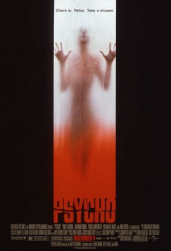
Film School: Psycho (1998) vs. Psycho (1960)

by XdarksparkX
Originally written for COM311 - "The Early History Of Film"
November 20, 2011

Usually when a director makes the specific choice to sign on to remake a film that already exists,  it’s often because he or she has a message that can be retold in a similar package.  The current climate of the Hollywood machine grants them much better odds of getting said message out through a remake rather than an entirely original film.  According to Hollywood, originality doesn’t sell like a film that explicitly channels the title and specific plot of a previously established story.

That being said, I still cannot fathom why I have to preface the term “Psycho” with “The Original” in a grumbling, almost venomous tone when referencing it within the context of cinematic history.  In this world, perfection is a simple illusion of the human mind when it is attributed to a medium that does not have a set number of feats attainable.  For instance, you can be “perfect” in Guitar Hero, because there are a finite and specific number of notes per song.  However it is metaphysically impossible to find honest, definition-bound perfection within the context of a property that exists with infinite possibilities, such as in film, music or life.  With that said, Hitchcock’s 1960 classic Psycho grazed the most attainable tips of perfection when it came to putting Robert Bloch’s novel onto a visual medium.  The way that Hitchcock presented the story worked in every single way.  One could argue that you cannot truly “improve” upon it because everything was done with not only a deep, thoughtful, and calculated precision, but because the artistic flares that one would consider things to “fix” are what make the experience so memorable.

So then why in the Hell of H.P. Lovecraft did a remake find its way into theaters in the winter chill of December, 1998?  Sure, if Universal was just that adamant about remaking Psycho, then who could blame Gus Van Sant for jumping at the chance?  That’s not my gripe -- my gripe is the fact that he was afforded the opportunity to take a revered classic that was being remade for the pure profit potential and not screw it up, only to be blatantly afraid of screwing it up and ironically screw it up by doing nothing with it and taking the dense way out.  Van Sant got away with simply looking at Hitchcock’s masterpiece, saying “this is how he did it, so that’s how we’ll do it” and calling it a day.  The saying that you can’t improve upon perfection (or in this case, near-perfection I suppose) still holds true, however how much of an oblivious moron do you have to be to willing put yourself up for comparison against near-perfection by attempting to do a shot-for-shot mimeograph of the original?  You might as well bring a knife to a gun fight and become surprised when you find a bullet lodged in your face.

It seems like Van Sant didn’t even try to think about the small idiosyncrasies as to why Hitchcock did what he did.  For example, a lot of Hitchcock’s Hollywood films were in Technicolor, so many of them that one could say Hitch was enamored with the process. So why is it then that he chose to do Psycho in black-and-white?  Personally, I feel it’s because of the ironic nature of having a film with limited spectral range that aligns with the common perceptions of Good and Evil, while the characters within the film are so morally ambiguous.  Marion isn’t exactly a bad person, but she isn’t a saint either.  We come to find out that Norman is just flat out insane, so while convenient as it may be to label him ‘evil’, that’s not exactly accurate.  The black-and-white coloring choice shows us just what we need to see, while at the same time commentating on the fact that what we’re seeing is simply the contrasts in between light and dark; everything that lies within is simply the tinted white and the deepest gray.

The killer in the wig about this to me is that both films were based on the novel.  So rather than isolate himself from the Hitchcock film, read the novel, and come up with his own interpretations of the events (updated to a late-90s setting), Van Sant chose to create a blatant reflection of the original film.  Make your film stand on its own, Gus.  Experiment with other camera angles, tinker with different lighting setups for certain scenes.  Get freaking creative, for crying out loud.  Borrow bits and pieces that you just felt Hitchcock did so masterfully that they deserve to be rehashed, but not the entire 105 minutes of the freaking film.

This is without even getting into the characters.  The fact that casting director Howard Feuer actually got a legitimate check for presenting Vince Vaughn’s headshot to Van Sant absolutely boggles my mind.  Now, I’m not one of those people who feels that  actors should be locked away in their genre of preference and have the key violently thrown away, however Vaughn had to have been near the top of the list for “Worst Potential Selections To Play Norman Bates”, and someone simply mislabeled the lists and handed Gus the wrong one.  I refuse to believe that his casting was intentional lest it was the last resort when all other potentials declined.  With Anthony Perkins, he brought an amazingly believable innocence to Norman.  He felt like someone who was isolated, but not someone who was completely bat-shit insane.  To this day, when I watch the original I still have to remind myself that he is the guy who acts as if his dead mother is still alive in order to fulfill the most warped and deranged sense of a moral compass.  The second Vince Vaughn steps on screen, an air of unease follows in his wake and permeates the audience.  His stiff, awkward delivery doesn’t help calm the fact that the “warning” lights in our brains are going off like Robot from Lost In Space just sensed that the Velociraptors have escaped from their containment area in Jurassic Park, and is proceeding to cycle his infamous “Danger! Danger, Will Robinson!” sound bite as the perimeter fence alarms blare all over Isla Nublar.  His awkward, forced chuckles lack any sort of intended adolescent introversion and instead violently scream “guy with a dark secret and something horrible to hide”.

Anne Heche I don’t have as much of a problem with, mainly because Marion Crane is arguably what Hitch would call a “MacGuffin” -- a plot device that exists for the sole purpose of moving the story where it needs to go -- so that the story can reach it’s true central character: Norman Bates.  However, in the sparse time she was on-screen there was one time where a display of cringe-worthy “acting” came into play.  During the scenes where Marion is driving away from Phoenix, I was always under the guise that the conversations we heard weren’t just those that were actually happening, but ones that she herself was playing out in her head.  However, while these conversations go on, Heche gives us little more than a wide-eyed “deer in the headlights” look as the conversations further incriminating her play in her head.  There’s no nervousness, or tension that we see from her expressions, she simply stares off into the camera like she’s about to have an eye exam.  I don’t recall Janet Leigh doing much with this either, but you could at least feel the apprehension from the character knowing that what she’s doing wasn’t right.

I think the principle problem with Marion’s character is that we don’t care about her, and Van Sant did nothing in an attempt to change this.  Even if in the original she was a very bland and simple MacGuffin, at least with the remake attempt to veil this and make her an interesting MacGuffin.  It’s only after she dies that we sit back and realize that we didn’t care about her at all; the horror we feel is that of pure shock that we supposedly just witnessed an overprotective mother commit murder because her son simply talked to this woman.  We never knew Marion’s true motivations for laundering the money, or where she’s even going with said money.  No exposition, nothing.  So why not take your remake and attempt to get the audience to connect at least a little with Marion, Gus?  Why not attempt to get us to the point that when she’s murdered, we at least feel something as opposed to nothing?

Now, whether or not the blame for these performances -- primarily Vince Vaughn’s -- and their lack of actual emotional depth falls on the actors or Van Sant is questionable.  If those of us who haven’t committed ourselves after viewing them remember correctly, the Star Wars prequel films were able to claim Natalie Portman as Padme, the primary female protagonist and eventual mother of Luke and Leia.  The same Natalie Portman that came off awkward and stiff in those films is the same one who was absolutely mesmerizing and won an Oscar for her performance as the lead in Black Swan.  Given the fact that -- through his track record -- we already know Lucas couldn’t properly direct actors even if his precious morning coffee and comfy chair in front of the monitors were in jeopardy, we can safely blame that bit of performance farce on him.  However, who do we blame this particular farce on?  Honestly, I want to blame both.   In Vaughn’s case, he clearly had very little in the way of an actual grasp on the character and his basic psychology, and therefore turned in a completely non-committal performance.  He toes the line of everything we already know of Norman and what we will come to know of him, and it ends up feeling completely… wrong.  Perkins committed to exactly what was required to know about Norman at that point in the film, which in turn made the final twist all the more shocking.  He was awkward due to years lacking actual human connection, and was strongly protective of his mother as she was the only thing he ever had;  it was much easier to accept that Vaughn turned out to be Norma that it was to accept that it was Perkins, because Vaughn let off a constant vibe of someone that hid a dark secret.  Van Sant on the other hand gets the blame only because within every other facet of the movie he was so desperate to mimic Hitchcock that he forgot to add creativity, and this could’ve very well been one of those moments where he simply pointed to the original performances as reference material and called it a day.

I think that the glaring difference between the films is simply a lack of vision, creative spark, or motivation to make a decent film when it comes to the Van Sant version.  There was a glaring lack of focus that resonates throughout the entire film.  They changed the year the film takes place to 1998, and while they change the monetary values to reflect this, everything else in the film has the distinct impression that it was pulled right from the worn pages of a 1950s Sears catalog.  There’s a mention of a Vinyl Records store, why?  Vinyl was all but dead by 1998 -- Hell, freaking cassette tapes were clinging to life support at that point.  Why not say that Marion’s sister worked at The Wall or something?  I don’t know if that’s the right answer to the problem, but just something that resonated closer with the 1998 music scene than freaking vinyl records.  Marion’s boss says something along the lines of “A cash transaction of this size -- highly unusual”.  Who spoke that way in 1998?  It’s amazing to me that the filmmakers claim that they had an actual focus on “updating” the film in the DVD commentary and yet completely missed so many glaring references to a different period.  I’m not going to even go into the astonishment I have for the fact that for all the things the 1998 version blatantly copied from the original, they specifically chose not to use the original Psycho house that is currently located on the Universal Studios Hollywood backlot.  Oh, was that just a bit too much blatant plagiarism for you, Gus? You ripped off everything else, including a majority of your shots, you might as well have taken the house down in the Titanic with you!  Ugh, where the hell did I put the Advil?

In the films, Norman Bates says “We just keep lighting the lights and following formalities”, and in an almost philosophical irony, that is exactly what the remake came out to be -- nothing more than a pathetic, expensive, blasĂ© exercise in filmmaking in which the director had no deep creative spark or passion for what he was putting forth onto the celluloid.  The 1998 Psycho should be the textbook example of everything you shouldn’t do when it comes to the art of filmmaking.  Have a vision that you can call your own.  Have infectious passion for what you’re doing.  Embrace outrageous creative ideas. Take chances and make mistakes in the wake of that creativity.  Just f’n give a damn.

Film School: Technological Evolution's Impact On Storytelling

by XdarksparkX
Originally written for COM 312 - "The Modern History of Film"
March 27, 2011

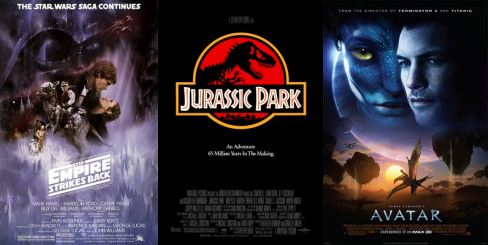
Star Wars: The Empire Strikes Back (1980), Jurassic Park (1993), and Avatar (2009).  These three films have one major thing in common: they are each considered great leaps in terms of cinematic visual effects for their time.  Empire improved upon the fantastic practical effects from it’s predecessor, A New Hope and managed to use matte paintings, miniature models, puppetry and stop motion animation to their fullest extents; Jurassic Park used gigantic audio-animatronics aided with subtle amounts of computer-generated imagery (or CGI) to bring back creatures thought to be extinct 65 million years ago; and Avatar showed the true technological capabilities of pure CGI and performance capture in the 21st century by creating a highly emotional and believable alien race who inhabited a fantastical alien world.  But were any of these leaps required in order to properly sell and enhance the story arcs in these films, or were they simply a case of the filmmakers being nitpicky in how their film was presented?

James Cameron was originally supposed to begin pre-production on Avatar immediately after the release of Titanic in 1997, however after numerous production tests he found that “technology was not where he wanted to be to realize his vision”.  While one could argue that he was right, one could also argue that after seeing the finished product of Avatar, it wasn’t a lack of technological advancements as much as it was Cameron’s own refusal to relent.  I believe the story of Avatar could have been told in the early 2000s with creative workarounds and a desire to make the story simply work.  For instance, was it important that the Na’vi be 10 feel tall (a design choice that surely helped sell Cameron on using CG when they would be interacting with humans)?  In the context of the story, no, their height holds no bearing on whether or not the story itself works or fails.  So the real question becomes, was it necessary to not only completely computer generate the Na’vi, but to spend 237 million dollars (The Wrap, 2009)—the fifth most expensive budget nominally as of this writing (The Numbers, 2011)—in order to tell this story?  While an epic fantasy movie like Zack Snyder’s Sucker Punch, which deals with outrageous imagery like giant Samurai’s and Dragons populating a dream world, manages to only claim an estimated 82 million dollar budget (Los Angeles Times, 2011).  Snyder’s previous film, an adaptation of the acclaimed graphic novel Watchmen in 2009, consisted of a completely computer-generated Doctor Manhattan.  While this was one character as opposed to an entire race, a convincing fully realized CG character using performance capture was still fit into a 138 million dollar budgetary constraint (that had to deal with Snyder being adamant about building sets rather than using vast amounts of chroma key compositing like he did with 300).  Avatar’s budget numbers don’t even included the money spent for on developing the “necessary” performance capture and 3D camera technology that were funded separately (Vanity Fair, 2009).  So what does all this mean?

Its possible that Cameron was simply blasĂ© with his budget, because when Twentieth Century Fox was hesitant to take the monetary risk on Avatar, he himself went ahead and put forth the money into developing the 3D camera technology he wanted (BussinessWeek, 2010).  By using his own funds to develop the tech, perhaps he had the wiggle room within his production cost wallet to experiment with said technology and attempt new filmmaking ideas and concepts, rather than to do something he knew would work for possibly less.  All of this could point to the reason why a lot of critics, myself included, found the story of Avatar to be the weak link of the film at times.  When I finally got around to seeing it, I just thought that the effects weren’t so much for the story as much as they were for Cameron.  In a sense, Avatar was a tech-demo—Cameron’s way of showing just how powerful the technology we have available is.  The visuals of the film are gorgeous, however in this regard I feel that visuals and storytelling in film have a relationship akin to that of game play and graphics in the video game industry—just because your game is pretty, doesn’t mean it’s great if the controls don’t work.

29 years before Avatar started bludgeoning box office records three times over, Star Wars Episode V: The Empire Strikes Back came around, and got its story across by making due with what it had, what was feasibly obtainable, and what could be created in 1980.  It’s budget of 18 million (roughly 47 million when adjusted for inflation) held up enough to get the visual effects to the point of believability, and some could argue that’s all that’s needed.  Sure, as Luke’s little mount known as a Tauntaun gallops across the frozen plains of Hoth in the opening sequence, we know it’s unnaturally stiff and therefore not actually real in the context the movie is telling us it is. But perhaps, because of the fact that the creature was an actual miniature that existed within this world, our level of acceptance stretches farther because random anomalies like unnatural lighting glitches don’t exist.  Perhaps we’re also already engrossed in what the film is selling due to the physicality that model brings, and therefore the slight that arises isn’t enough to jar us out of the moment the film is putting us in.

The reason for pointing out Empire as opposed to its predecessor A New Hope (which holds many more similarities to Avatar production wise), is that it while A New Hope contained the formation of Industrial Light & Magic (who would go on to be one of if not the biggest effects house in the world), it was the Hoth battle scene at the beginning of Empire that I really wanted to touch on.  Yes, it may be more time consuming to do stop-motion animation (or in this case, “Go-Motion”, ILM’s own version of stop-motion animation developed in conjunction with Phil Tippett), but in the end those stiff and slightly awkward movements only fit to make the Imperial AT-AT walkers look all the more realized.  As seen with the many “special editions” Lucasfilm has churned out of the original Star Wars trilogy with “updated effects”, newer isn’t always better, and the story itself does not suffer if one watches the theatrical cuts of the original trilogy—difficult as they may be to actually obtain—with the original practical effects intact.  I personally feel that the newer effect almost cheapen the films, rather than enhance them as Lucas intended.

The reason for this being that when you have practical effects, the viewer knows that its something tangible, something with weight that existed on the set.  The lighting is the same, the shadows are the same, the colors and textures are the same as the human actors and everything else on the set, because it’s actually present.  When Mark Hamill speaks to Yoda, he has not only the puppet and its movements for visual reference, but Frank Oz’s own performance to play off of.  When interacting with a pure CG character, seldom is there a time where there isn’t at least a partial disconnect due to the awkward nature of having nothing in essence to work with.  Perhaps this coincidentally explains why Cameron wanted so much of Avatar to be CG.  By making the Na’vi themselves CG, it makes them seem more at home with their CG-laden homeworld of Pandora and the other indigenous creatures it claims.  In that regard, I understand his thought process through the technology/story connection, but I don’t know if it completely sells me on it, because in scenes where the humans and Na’vi are interacting (like during the climax when Neytiri holds Jake’s asphyxiating body in her arms) there is something just… off that just doesn’t make what I’m watching believably real.

All that said, surely it would seem impossible to make anything CG seem tangible within a film—to get the viewer to believe 100% that whatever they are witnessing isn’t so much a fable as much as it is a documentary of fantastical proportions, while never allowing their minds to really slip into the uncanny valley.  However, in 1993, a thunderous boom echoed out, and Steven Spielberg shut down the perimeter fences and unleashed Jurassic Park upon the world.

Originally, Jurassic Park was set to use “Go-Motion” for the dinosaurs during long shots, and Stan Winston’s animatronics for the close-ups.  However, after the Go Motion test animatics and various attempts at motion blurs proved unsatisfactory to Spielberg, two animators began working on a CG T-Rex skeletal walk cycle, and upon review were approved to do more.  The first full CG animatic they showed Spielberg and Tippett was of the T-Rex hunting a herd of Gallimimus.  The exchange between Spielberg and Tippett after witnessing this feat—“You’re out of the job”; “Don’t you mean extinct?”—found its way into the film, and was ironically the beginning of the end of the practical effects era.

However, perhaps it shouldn’t have been.  For while the advent of CGI in this regard was huge and the primary focus of the praise of the film’s effects, maybe the true praise should’ve been put on the seamless transitioning of the CG dinosaurs and Stan Winston’s fully realized animatronics.  When the Rex smashes through the tour cars roof in an attempt get to Lex and Tim, that was something that could have never feasibly worked on a emotional and psychological level if done with CGI.  The close proximity that the Rex was required to get within pertaining to the children meant that you would have something tangible (the actors) attempting to cater to something intangible (the Rex)—they wouldn’t have been reacting from what the Rex was doing, they would’ve been telling the Rex what to do wherever they moved the shattered plate of glass.  Certain emotions can’t be faked either, like the one of lingering terror that exists in the back of one’s mind when they realize that a giant mechanical T-Rex head is barreling down upon them with the potential horsepower of ten muscle cars.

One of the most iconic scenes in the film comes after the Rex escapes from its pen, and its foot steps right behind an unsuspecting Alan Grant as he tries to free the children from the now overturned tour SUV.  Aside from the shot being beautifully constructed, it’s another instance where no matter what tactics they would’ve tried, it would not have been had the same power and haze of reality if it had been achieved through CGI.  That was real weight from that animatronic skeleton pressing down into that mud, “real” latex skin that folded just right upon its placement.  Tangible, believable… real.

I think the problem faced today is that the current powerhouses of SFX like ILM and WETA are being overworked.  CGI has become such a crutch in the industry that these effects houses are constantly on a time crunch to get anywhere from 200 to 300+ VFX shots finished, approved, polished and finalized.  All before a deadline of say roughly 90 days.  An example of this: say you pull 10 CG artists off the floors of ILM today and 10 from the team that worked on Jurassic Park in 1992.  Today, because films are requiring so many Visual Effects shots to be completed, those 10 artists are probably working primarily on an entire scene by themselves.  Whereas in ‘92 with Jurassic, one person could (hypothetically) meticulously work on the animation of the T-Rex when it breaks out of it’s enclosure, while someone else is specifically working on the rain refraction on the skin, making sure that every drop falls and disperses as it should according to real world properties and that the determined light source is accurately reflected through this as well.  This is just my own theory, however it is obvious that as SFX houses have been spread thinner, the finer details that were seen in Jurassic Park have been lost due to sheer volume of work and time in which to complete said work.

In conclusion, I think that the best storytelling tool is a moderation of both practical effects and computer generated imagery.  CGI has become a crutch, when at its original rise to popularity it was meant to be a tool—a simple technological puzzle piece to aid in bringing a director’s vision to life.  While Avatar is a huge selling point for the true potential of CGI in this day and age, I feel that Jurassic Park showed the power of moderation in a perfect way, and that practical effects don’t nearly deserve the shunning that they’ve received from the Hollywood machine of today.  Not to mention, given the fact that the highly touted stance is that CGI is cheaper than practical effects, if you were to adjust older movies that use extensive practical effects for inflation, few would even come close to the budgets of the blockbusters today.  So how much cheaper is CGI really?

Perhaps it’s a joke—a metaphorical knock-knock with an unknown punch line.  How many licks does it take to get to the center of the money pop?  The world may never know…

_____________________________________
Patten, Dominic. The Wrap,
http://www.thewrap.com/movies/article/avatars-true-cost-and-consequences-11206 (2009).

The Numbers,
http://www.the-numbers.com/movies/records/budgets.php (2011).

Los Angeles Times, 
http://latimesblogs.latimes.com/entertainmentnewsbuzz/2011/03/movie-projector-diary-of-a-wimpy-kid-rodrick-rules-sucker-punch.html (2011).

Vanity Fair,
http://www.vanityfair.com/online/oscars/2009/12/how-much-did-avatar-really-cost.html (2009).

BusinessWeek,
http://www.businessweek.com/magazine/content/10_05/b4165048396178.htm (2010).

Saturday, September 24, 2011

SAW 3D: What Became Of The 2010 "Scream Queen"?

So two months ago I finally got around to watching SAW 3D (aka The Final Chapter) thanks to an EPIX weekend-long channel preview on FiOS. The main thing I wanted to see was the type of role Gabrielle West—winner of the second season of Scream Queens in which the grand prize landed her the role—had in the film, since they actually gave the previous winner a pretty intriguing side-character. So, lets see the role that Gabby secured.

WARNING: Gratuitous Over-The-Top Violence Ahead


…That’s it? You trained her up, you spouted all this bullshit about “how versatile of an actor you have to be to win this competition” and THAT’S what she does? Scream, cry and plead before her head gets a permanent tread-mark run through it? Are you serious?


“…What a fucking waste of my goddamn time.”

The killer is, not only did the original SQ winner Tanedra Howard do more in her first appearance in the series, she makes a recurring appearance in the VERY NEXT scene. That’s… that’s just laughable! Tanedra has more to do in this film than Gabby West! Breakout role my ass, Gabby just became Saw cannon fodder.

To me, I almost feel like this is a statement on how the judges overrated Gabby on the show. I mean, lets be honest, you couldn’t exactly cast Jessica Ortiz as the girlfriend of a skinhead, but I don’t get why they weren’t competing for the role of Sydney, who’s at the Jigsaw Trap Survivor Support Group in the same scene immediately after Gabby’s that Tanedra makes her appearance in.


That was a small role that required everything Homa had trained the girls on, and could’ve very well been considered a small breakout role. I also think it would’ve been a clever little wink to the fans of the show to have Tanedra and Gabby’s characters interact with each other, especially given the fact that Tanedra’s character calls Sydney right out on the carpet for not truly having to sacrifice anything in order to escape her trap. A character who has to recount the trap she had endured, complete with short flashback, seems like it should’ve been the most obvious choice for the role of the second VH1 Scream Queen. Nope, instead what I joked would happen with Tanedra happens in the second go-round with Gabby—pure body count ammunition.

Perhaps Tanedra, and her prominence in this film, is the reason I find this so funny. I said (many times) in my coverage of SQ2 that Gabby was terribly overrated by the judges, and that she really had a hard time quickly channeling the required emotions while also being on top of the technical aspects of the scene. Perhaps the filmmakers of Saw 3D picked up on this as well and as such gave her such a terribly weak role when they made sure to give the winner of the first SQ a follow up role. It just seems like a complete and total waste of the time of everyone involved with SQ2 to give the winner of the competition such a throw-away role. What a damn shame.

Sunday, August 7, 2011

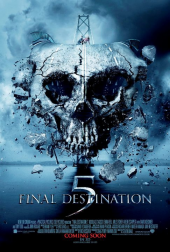
Who Greenlit This Shit? Edition II - "Final Destination 5"


by XdarksparkX
Originally Written: August 7th, 2011

Normally I don’t completely rip into a movie and call it a complete waste of time before it’s released unless drastic measures call for it. However, I’ve been having these thoughts about the Final Destination series as a whole for a few years now, and after watching the trailer for Final Destination 5 for the third time, I think I’m finally able to construct my thoughts into more than just nonsensical expressions and gestures of rage:

Without seeing a single frame of the final cut, I know for a fact that this film will be complete crap.


The Final Destination series has been on the down and out since the first sequel was released back in 2003. FD2 was okay for a sequel, but the filmmakers completely missed the essence of what made the original FD an awesome film. The fact that through logic, Alex was able to figure out a pattern of the order the people who got off the plane could die in, and that when he inevitably failed to save most of them from the grim fates that befell them, there was very little in the way of supernatural instigation—most of the deaths were a freak one-off deal that was sometimes over emphasized (Ms. Lewton’s death) to show that no one, Alex or other, had any actual control over the events. No one ever stated that Alex’s pattern was definite fact, it was merely his own cockamamie theory that just happened to come true at every turn—it only became accepted because it continually turned out to be right.


With the subsequent sequels, something changed. Gone was the creative drive that powered the first film, instead it became a part of the infamous Hollywood cash cow. Everything taken in the first suddenly became the considered “rules” for the series, making it terribly trite and predictable. Just look at the grandiose opening “accidents”, which became a staple of the series. In the original, Alex had a dream about a horrible accident taking place where the plane he was on took off and suddenly exploded. Not only does this work because he falls asleep when he gets on the plane (an arguable point of how he fell asleep that quickly, but still it’s a much more valid setup that what succeeded it), but they had previously established that he has a terrible fear of flying. This is why the “premonition” made perfect sense in FD1
it could’ve been real, it could’ve been his overactive phobia tainting his imagination, but the second that plane bursts into flames after Alex and friends get kicked off the plane, it becomes invaluable knowledge to the survivors that cannot be argued.

With the subsequent films that followed, the filmmakers literally just pick a random point where they can switch to the “premonition state” under the table without the audience knowing. Then, after the overdone gruesome “accident” (which starts to become laughable when you realize that they need to have to visionary die last in the premonition, in order to be able to tell the other survivors the “predetermined order” that they will die in), they do that “super zoom out of the eye” shot back to the aforementioned random point just before the “accident.” No dream, no nothing… these people are literally touched by a random bout of psychic powers for absolutely no reason what-so-ever. It begs the question, if Death is just going to get pissy when it‘s over-elaborate plans are thwarted, why doesn’t it just flip the script and kill the person who HAD the premonition first? Good luck finding out if anything’s amiss now!


You may have noticed that when referring to the opening deaths, I refer to them as ‘accidents’ with intentional quotes around the word. This is because the events that begin the first act in the subsequent sequels aren’t so much believable accidents as much as they are nonsensical apparatuses with as much over-complication as a classic Rube Goldberg device. These aren’t accidents, these are the events that unfold when some vague metaphysical force plays a game of goddamn Mouse Trap. I let FD2 off the hook slightly in this, as the human control of a motor vehicle allows a margin of error in judgment and reaction time to make that accident an actual… well, accident. However, from 3 onward, the opening scenes are so unbelievably convoluted, all while attempting to achieve the simplest means—death.


I don’t even know if I should really get into the logical fallacies of the latter opening sequences; I could easily write a 20 page diatribe about how the Roller Coaster accident in FD3 was complete bullshit that goes against every single law of basic coaster design mechanics, but I won’t. Just for shits and giggles though, here’s a list off the top of my head of logical and mechanical failures from that sequence:


  • The Devil’s Flight’s shoulder restraints bounce up and down when released. Any coaster that EVER did this would not pass State Certification for Amusement Ride Operation.
  • There is no backup restraint for the shoulder harnesses. No seatbelt, no belt that attaches to the harnesses, nothing. When that one valve fails, everything goes to hell. On every modern coaster there is always a failsafe on the restraints, even if that means doubling up the exact same mechanism so that if one fails, the other is the backup. The odds of both of them failing is astronomical. Not to mention, that one valve apparently held the restraints for the ENTIRE train. Nope. The trains are locked usually by car, but sometimes in sections depending on the maker. Either way, one failure like what was shown would not cause the entire train’s restraints to unlock.
  • We are to believe that a camera, dropped by a foolish rider, wrapped around the track and was the leading cause for wrecking the train’s wheel assembly. HA! Are you kidding? That camera would’ve been absolutely wreckedthe worst thing that would happen is the train would lose momentum and valley (stall) at a low point where it lacks the inertia to climb the hill in front of it. Those wheels are attached to a train that weighs a probable ton without inertia or riders—fully operating, it would chew that camera up with barely the bat of an eyelash.
  • Speaking of the wheels, there are three wheels on a coaster car’s wheel assemblies: the road wheel (rides on top of the track), guide wheel (rides on the side of the track), and up-stock wheel (rides underneath the track). In the film, these wheels and their specific states fluctuate randomly depending on what the scene called for. For instance, the remains of the coaster train goes into the loop and stalls at the top; flipped upside down. This means that the up-stock wheels are still intact, if they weren’t the train would’ve fallen once it lost enough momentum and crashed into the track below. However, the train instead rolls back and hits a piece of track that had been completely jarred out of place (don’t get me started on how this happened), before the suddenly halted momentum causes the front end of the train to fly completely off the rails and spiral towards the ground.
  • As more of a side note, the Ride Operators are possibly the most idiotic people to ever walk the face of the Earth. After Wendy flips out they let her and the rest of her section get off, however both her boyfriend (my boy Jesse Moss) and Ryan Merriman’s girlfriend (Carrie) are in the front row and therefore still locked in their seats. (Wait, so they unlock sections of the train at the loading platform, but that one valve controls the entire train’s locking mechanism!? WHAT THE FUCK!?) Then, when Jesse’s character and Carrie are looking the Attendant dead in the eye asking to be let out, they get completely ignored and the guy says to the operator “you’re all clear! Start the ride!” NO. NO, NO, NO! If someone asks to get off, and are legitimately serious and not messing around, YOU HAVE TO LET THEM OUT. All of those Ops should have never been anywhere near an operator’s panel or ride attendant job position.
There are MANY more points that I could dissect if I actually took the time to look the scene up and wasn’t going from purely from memory of the big points that stuck out, but the point is made just the same. To sum up, they might as well have had someone get thrown in front of the car, and then attempt to avoid being hit by doing a Scooby-Doo esque “spinning of the wheels” startup before running in front of it within the same vein as a Looney Tunes cartoon. THAT would’ve been within the realm of reality they were working in.

…Does it show that I was a Ride Operator at Six Flags for three years?


Now, I’ve heard fan boys of the series attempt to proclaim “it’s only a movie” when I’ve brought these points up, but to argue that point is to completely whiff on the purpose of the series and it’s brand of horror/suspense. If I as a viewer am fully and completely conscious of the fact that I’m just watching bland characters die in ridiculous ways, then the entire existence of the movie within the guise of being apart of the Horror genre is pointless. I don’t think about how dangerous the objects we use every day without a second thought are, but rather I spend my time laughing at the fact that they expect me to buy into this with any legitimate emotional investment.


And the openings only got worse from there.


FD4’s tries to make us believe that stock car raceways only have rusted chain-link fencing between the track and the spectators, along with serious cracks and fractures in the seating area at a point of primary structural support. FD5 then attempts to make us believe a suspension bridge has COMPLETELY failed and caused the roadway it holds up to crumble like a soggy Oreo cookie. The openings became more about Michael Bay inspired “insipid flashiness” than about logistical and psychological horror.


At least in the FD5 trailer, it seems like they don’t just randomly come across the information of a similarly crazy incident where people survived because someone predicted it minutes beforehand on the internet or something like previous films (who thinks to Google that anyway?) Instead, the cryptic coroner of the series named “Bludworth” (Tony Todd) is at the site of the mass funeral for those who died on the bridge and says to the protagonist and co. that he’s seen this before: the freak accident, the random survivors… and death hunting them down one-by-one. It’s better, but that’s like saying it’s better to get hit by bird poop than step in dog shit.


The worst part is, the Mouse Trap shenanigans that the openings contain don’t just happen in the opening scene in the later films. Oh no, these unbelievably improbable chain reactions actually start to bleed into the subsequent “accidents” that Death uses to correct the wrongs and right the fates of those who avoided his cold embrace in the opening. It gets to the point where they are willing to throw anything—including basic logic and every single one of the laws of physics known to man—out the goddamn window just to get a “cool” death scene. It gets even worse when they start knowing that people expect it to the point where they use chain reactions just to have them result in a near-miss /
close call moment. Great, yeah that’s it, pander to the absurdity that you so proudly flaunt as a “series staple”. I should punch each and every one of you bastards in the soul.

Since this is supposed to be about 5 (and has turned into a much broader reaching rant), I’m going to try and keep this rant about these within the realm of what I saw in the trailer.

  • Floor to ceiling windows that are in high rises and multi-story office buildings are NOT shatterproof nor massively thick. This is a common misconception. Having them posses those traits in the name of safety would just be laughable, because there’s zero chance that someone would EVER slip and fall into them. Besides, if a window washer sees something going wrong, they need to be able to make an immediate breach and entry. Window Washers: Saving the day, one window at a time.
  • “I see that it’s been quite a while since your consultation for this laser eye treatment…what made you decide to take the leap today?”
    “A lot is going on in my life, I don’t want to miss anything.” *starts violently shivering after sitting in the chair* Jesus, then get fucking CONTACTS! My God, if you’re flipping out like this why are you doing it in the first place!? Oh wait, because then we can’t have an incompetent doctor leave you alone with your eyelids pried open and a high powered laser aimed directly at your retina!
  • Death by falling on Acupuncture needles? 1000 Ways To Die already did it.
  • A sheet metal screw can come loose from a ceiling bound air-conditioning unit in a gymnasium and fall with the most ridiculous precision onto a balance beam, landing flawlessly on it’s head without reacting to the fact that it’s momentum was suddenly and forcefully halted. Physics: “screwing” Netwon and his supposed laws whenever the hell it feels like it.

And just as a bonus lesson courtesy of FD3, remember children, an engine does not need to be hooked up to your truck for you to be able to actually drive it. It can simply rest under the hood as if it was conveniently placed in a trunk, which allows it to fly completely out from under the hood when a runaway van rear-ends you, sending the engine fan right into the unsuspecting head of the douchebag in the convertible in front of you in the drive thru line at McDonalds. Oh, and the douchebag’s car won’t move either, because as we previously established… physics isn’t an absolute or anything. It takes more plays off than Randy Moss when Death is the QB.

As if all of this wasn’t fail-tastic enough, in the 5th film Bludworth informs the survivors that because they aren’t supposed to be here, the only way to appease death is to kill someone else in their place. Wait, why didn’t you tell the kids in the first one that? What, is this a new development in the way Death operates? Did you read about revisions to the “How To Handle Those Who Escape Plans of A Horrific Fate” section of the Grim Reaper Rulebook in the newest edition of Afterlife Quarterly? What happened to the “only new life can defeat death” crap you spun to AJ Cook and her cohorts in FD2? Jesus man, are you ever consistent? Stop acting like the information you present is an absolute rule when it changes every five seconds! Your “rules” are more sporadic than the presence of physics in these movies!

[Sigh] … You know, for a film series called “Final Destination”—where the main subject of interest in the plot is death—they sure seem to have a hard time actually getting to that very destination and letting this series just fucking die in a ditch already. I wish Hollywood’s obsession with formulaic crap would reach it’s Final Destination. [Cue rimshot; subsequent tomato throwing] Thank you, I’ll be here all week!

Monday, April 18, 2011

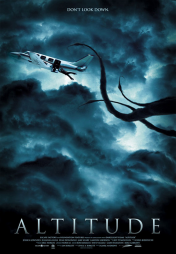
Altitude


by XdarksparkX
Originally written: April 17th, 2011
[Images courtesy of Dread Central]

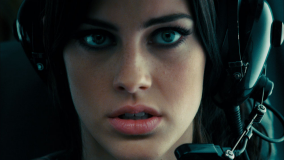
God damn it Jessica Lowndes, we have got to stop meeting like this! Here we are againyou’re starring in a suspect indie-horror film, and Im stupidly intrigued to see it simply because you’re in it. This will never last if we keep this up…

Thankfully, this movie not only prominently displays the reasoning for why I’m so enamored with Jessica, but it is also leagues better than Autopsy (a praise that seems feeble after my drubbing of it, but still accurate and valid). In fact, I could go as far as saying that I enjoyed the majority of Altitude for what it was. However, the bookends of the film grind my gears to no end, especially the ending, which is so putridity Hollywood I had to forcibly restrain myself from vomiting all over my keyboard when the end-credits hit.


Before we get there, there are some good points I can actually bring up about the film. The first of course being Jessica’s performance. Once again, my girl came to play. While I have seen better from her, this was no where near the train wreck performance she put out in Autopsy—this is definitely on the upper echelon of her career
’s performance hierarchy. I think director Kaare Andrews’ ability to recognize her potential and talent helped that, so kudos to him. Apparently Jessica also went out of her way to do extensive research to make sure that her aviation jargon and such was believable, even going as far as taking flying lessons. I’m no aviation expert, but she damn sure sold me on it.


See girls? You can still be pretty and not suck at your craft!

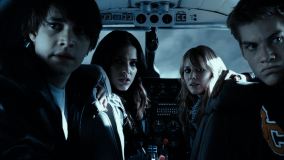
As a matter of fact, now that I think about it, everyone in this film was solid as far as performances go for a movie of this quality, and that’s huge when the script calls for your main cast to be isolated with each other in a small confined space for a majority of the runtime. I mean, could you imagine what The Breakfast Club would’ve been like as a character piece had the actors just sucked complete ass? I shudder at the thought.


Impressive... most impressive.

The only person who’s performance I had a problem with was Landon Liboiron, or as I call him when knocking the crap-fest that Degrassi: The Next Generation has become, “Eyebrows”. I don’t know, I just never feel like he is actually emoting at any point in the entire film. I get that his character is supposed to be emotionally distant, but I mean when everyone else around you is actually turning in semi-decent performances and you’ve got an air of “I don’t give a shit” / “uhhh what? about you, it stands out like an NBA player at a jockey convention.

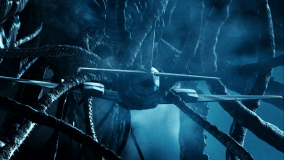
I also must say that the visual effects are phenomenally well done throughout 99% of the film (there
s one really obvious scene at the end that looks bleh), and when you consider the paltry budget they had to work with, its a pretty astounding feat to accomplish. Most of the visual effects shots are so well done, you wouldnt even think they were VFX shots, and thats more than some mega-budget films can say...

Now comes the bad. First off, the way the movie kicks off is a great framing point with a mid-air plane collision, but in that short 5 minutes it becomes painfully obvious that the child on the plane will play an extremely significant role, and the second Landon shuffles into frame it hits you like a Captain Obvious freight train.


Also of note in the character-establishing scene, Julianna Guill’s character Mel randomly states that she’s a film student in the opening. Yet not two minutes before that we saw the first shot of her using her the camera, and we can clearly see that the damn thing isn’t on—there’s no picture in the LCD viewfinder. Not to mention, every so often during the first half-hour or so they cut to her camera’s perspective, yet the digital quality they show the camera to capture is so atrociously bad it’s almost laughable. It honestly looks like it was recorded on a cell phone from five years ago, not an actual DV camera as portrayed. Film major my ass! No self-respecting film student would bother owning such a blatant piece of trash, no matter how cheap they got it. This information never comes back in any substantial way either, so it
’s basically a piece of pointless character exposition.

Once the plane gets off the ground, the film actually becomes a pretty damn decent thriller film. It all looks like smooth sailing, until they are swallowed by a supernatural storm cloud and Jess isn’t instrument rated, which means she has to visually maintain separation from the ground at all times. A loose screw channels the Final Destination series and conveniently lodges itself into the elevator controller, making it impossible for Jess to taper off after she realizes that she can’t pull up over the storm, and shit has officially hit the fan. Is it perfect? Not on your life, but it’s damn sure entertaining, and the dialog is pretty damn solid as well. Jessica frequently calls Jake Weary’s macho-jock character Sal out on just about every stupid idea he comes up with when he’s in his three sheets to the wind haze (seriously, drinking is one thing, but this dude is a chronic alcoholic—he continually washes beer down with more beer for the first 40 minutes of the film).


The scene that really had me applauding Paul A. Birkett’s writing was when Sal starts flipping out and saying they should draw straws to see who gets the lone parachute on board. Jess proceeds to go into a highly logical rant about not knowing who packed the chute, if it’s packed properly, or how high they actually are. “You think we’re 10,000 feet up, but if we’re only a thousand, you’ll hit the ground before you can even deploy the chute!” My god, was that just a smart, logical argumentative point in a low-grade thriller / horror film? Did the devil by any chance happen to ice skate to work today?


This is not to say the writing is without its faults though. The aforementioned useless character exposition that takes place in the beginning aside, most of Sal’s asshole-ery comes out of far left field from Parking Lot J with little to no actual provocation. This would work, if he actually gave off the vibe of a true asshole the rest of the time instead of just a cocky jerk. It’s almost like at intermittent points during the writing process Birkett said to himself “I need to remind the audience that Sal’s a dick.” Yeah, we got that. You don’t need these stupid, random things that can only really be backed up by the terribly flimsily argument that he’s tipsy to happen for us to get that.

Then comes the ending… dear god, what in the hell of all that is went wrong here!? My frustration with it was actually compounded by the fact that I watched the behind-the-scenes documentary on the DVD after the film, and found out that the original script ending was leagues better conceptually. After Jessie kisses Eyebrows and he says “you didn’t mean it, did you?” The clouds would’ve parted and they would’ve slammed right into a mountain, abruptly ending the film. I would’ve taken that and ran with it, when put into comparison with what ultimately ended up on film!


The major problem is that for the first 75-80 minutes of the movie, they have set their ground rules as far as feasible possibilities go. Yes, you can introduce something new in the guise of a major twist, but you can really only do it once. After that, you start pulling serious Hand of God / Deus Ex Machina bullshit out, and the audience you’ve manage to captivate is so
violently thrown by the turn of events that they get ripped out of the film.

So they find out that Eyebrows is the one causing Cthulhu to come after them (the creature doesn’t have a name, so I will refer to it as that from here on out), simply through his imagination and fears. Okay, so there is your twist, it’s become a psychological thriller type of deal. Right, you’ve used up your big twist—Cthulhu’s existence is purely the power of imagination, and can be stopped if Eyebrows would just stop being such a “goddamn pussy” (Jessie’s words in the film, not mine!) and just think of happier times. Of course, he can’t… because the dumb shit was probably under the covers reading the Necronomicon before going to bed every night when he was eight years old.


That is not dead which can eternal lie...

So, this should be it—your story’s resolution should to come within the context of this twist. Nope, not the case with Altitude. Instead they attempt to add another twist, using—of all things—time travel.

No. No, no, no, no… NO! Damn it, Andrews! You have officially thrown the carcass to the wolves; you have disengaged your audience with this overcomplicated nonsense. Why in the Lovecraftien hell would you do this!?

Now, surely some people are going to say, “well, you can buy the fact that Eyebrows can manifest Cthulhu’s disembodied head from the depth of the sunken city of R’lyeh, but you can’t buy that he can take them back in time?” To answer that: yes, I cannot buy that for a second. Aside from the fact that their earth-shattering twist was already well done with the teasers and eventual appearance of Cthulhu, at the same time it’s fantastical within the depths of imagination—like a schizophrenic’s psychotic episode, who are we to tell them what they are seeing isn’t real? I actually thought that would’ve been a great commentary as a whole for this film; but alas, by throwing the time-travel twist into the finale purely to achieve that ham-fisted bullshit Hollywood ending, they’ve created a climax that I simply can’t support. That is because it feels like the biggest crutch job in the world. Kaare tries to justify this in the BTS doc by saying that “by [the characters] allowing themselves to die in the present, they’ve saved a better version of themselves in the past, where their families are not killed and there’s no emotional baggage that keeps them from being together.” That’s all well and good, except for the fact that it makes no logistical sense!


OH, COME ON!!!

When you deal with time-travel Kaare, you need to be VERY careful if you want to make it legitimate. My rant on the Cameron’s Terminator films illustrates that—you have to think in terms of linear time progression in order for your time-travel plot point to work. What you’re saying Kaare is that they somehow saved themselves from the fate of the movie by going back to the day the crash happened, SOMEHOW REPLACING THE PLANE THAT CLIPPED THE ORIGINAL WITH THEIR OWN, and making a ‘better life’ for themselves? I hate to break it to you, but the other plane would still be there! They didn’t make Jessica’s mom (who was in fact the pilot of the plane little Eyebrows and parents were on at the beginning of the film) alter course—in fact, they didn’t make the original plane do anything except say “holy shit, where did he come from?” GAH! What is it with people trying to make time a loop; it is a continuous linear progression of events! Why is it that the only film that managed to get this right is Back To The Future? Look, there is an initial progression of events. If you jump back to one of those events, your presence can alter said events and potentially erase coming ones from that point on, but those initial events will still unfold exactly as they did when you weren’t there until you intervene!

Here’s the best way I can put it—I’ll partially regurgitate what I said in my Terminator rant.
Think of time in the sense of a piece of string. Now, as pivotal / memorable events happen, you tie a knot at a certain point in that string. So eventually you’d have this piece of string with knots at various points. Now suppose you added a time-travel variant to this idea, and decided that at the tenth knot you wanted to go back to the fifth. Whether or not you alter it from then on, the fifth knot will still exist as it did when it was originally formed when you go back to it. It only changes when you mess with it after revisiting it.

Now, imagine that you took the current end of your string, and you looped it back to that fifth knot. Congratulations, you have just created a paradox! Because think about it, if now the plane that was supposed to hit them at the beginning was really Jessie and Eyebrows from the future, how can they get to the point where they get caught in the storm if they now live “happily ever after?” Exactly, they wouldn’t—at some point they would have to have the events of the movie happen because it’s the only way to get to that false hope of happiness. You haven’t rewritten a happier life for yourself; you’ve actually DOOMED yourself to constantly end your life at 21 on that plane so you can have a ‘better childhood’. Because technically, you will now be forced to exist in an infinite circle, because the only way the past can happen is if you go back to the end of the circle you’ve created. And where does a circle end? Wherever it begins—it always comes back around.